The Machine That Cannot Stop:
A Systems Analysis of US Sanctions
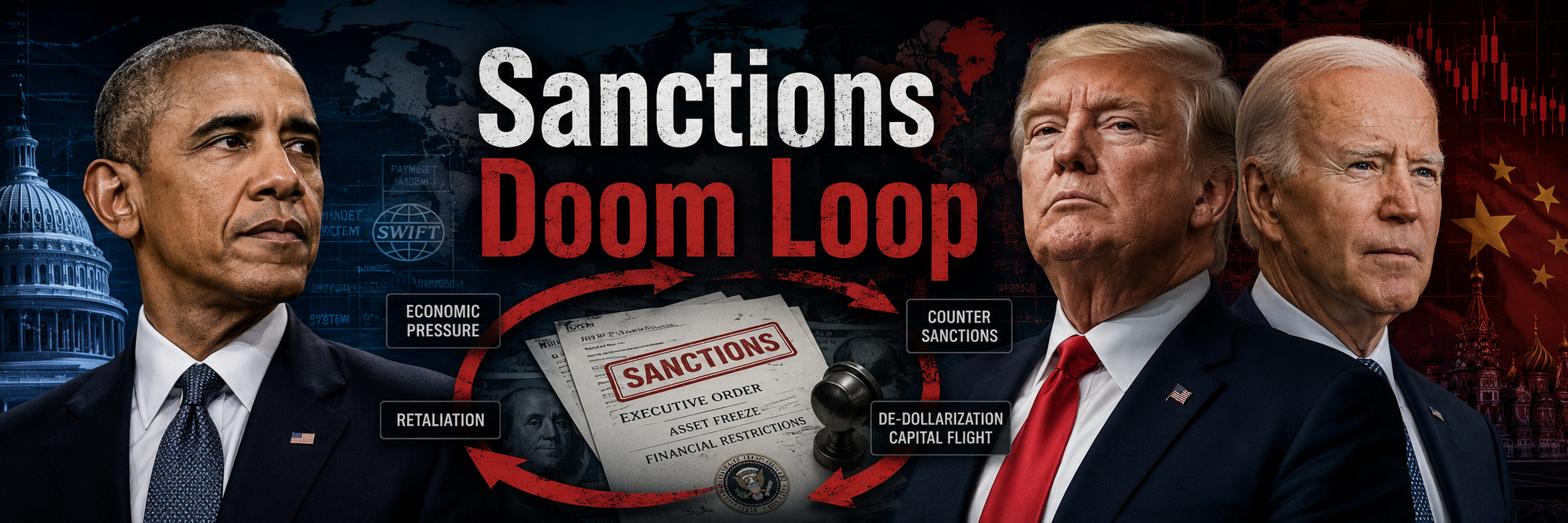
How a Cold War–era legal loophole became a self-reinforcing global enforcement apparatus — and why its greatest threat is itself.
The US sanctions regime is not a policy. It is a system — and like all systems, it has a logic of its own that long ago outgrew the intentions of any single president, Congress, or Treasury secretary. What began as a handful of country-wide embargoes in the 1990s has metastasized into more than 14,000 individually designated targets across 38 active sanctions programs. Understanding why requires looking not at the rules, but at the feedback loops.
1. What the System Actually Is
Strip away the press releases and you have a global financial enforcement machine with one primary actuator: the US dollar. Because roughly 88% of foreign exchange trading, 60% of global reserves, and 40% of SWIFT traffic run through dollar-denominated clearing, any entity that wants to participate in the global economy must route transactions through US-regulated banks. Those banks, facing strict liability for even inadvertent sanctions violations, screen every transaction against the SDN (Specially Designated Nationals) list. The result is extraterritorial jurisdiction without a treaty — enforced not by soldiers, but by bank compliance officers in Frankfurt, Singapore, and Tokyo.
"The mental model that powers it: The dollar is irreplaceable. No one can bypass the US financial system at scale. Therefore, denying access to it compels behavioral change."
The machine has five main categories of actor:
2. The Feedback Loops — How It Grows
Systems don't expand because someone planned the expansion. They expand because their feedback loops reward expansion. The sanctions regime has four accelerating loops and only weak brakes.
R1 The "It Works" Loop — The Primary Engine
The 2015 Iran nuclear deal was the inflection point. When Tehran came to the table, Washington concluded it had found a genuine strategic substitute for military force. Sanctions became the tool of first resort — not last resort. The cases where they demonstrably failed (Cuba: 60+ years, North Korea: 70+ years) were reframed as evidence of insufficient pressure, never as evidence of the tool's limits.
R2 The Compliance Moat Loop
Global banks now spend $65 billion per year on financial crimes compliance. Once a bank has sunk $50 million into sanctions-screening software, adding more names to the list has near-zero marginal cost. The banking industry has stopped resisting expansion — it already paid for the infrastructure.
R3 The Category Expansion Loop
Each new domain validates the tool for the next: terrorism → narcotics → WMD → human rights → cybercrime → scam compounds. The horizon keeps moving. Environmental crime and AI safety are already in the legislative pipeline. Every expansion is framed as applying a proven tool to a new threat.
R4 The Legislative Ratchet
Voting for a new sanctions bill costs Congress nothing and signals toughness. Voting against it signals softness on terrorism, Russia, Iran, or human trafficking. The number of underlying legal authorities grew from 69 in 2000 to 176 by 2021. Not one major program has ever been terminated. Cuban sanctions: 1962 to present. Iranian sanctions: 1979 to present. North Korean sanctions: 1950 to present.
"The system has no muscle for ending. It only knows addition."
3. The Brakes — And Why They're Failing
The system has balancing loops — forces that should moderate growth. Each is being overwhelmed.
B1 The Dollar Erosion Loop — The Most Important Dynamic Nobody Watches
This is the existential threat to the system, and it operates on a 10–20 year delay. Every country that watches the US freeze a central bank's reserves draws the same lesson: keep your reserves out of US Treasuries. After Russia's $300 billion in reserves were frozen in 2022, non-aligned countries didn't just talk about diversification — they acted. China's CIPS payment system now processes around 1.5 million transactions per month. Russia-China trade runs 70%+ in rubles and yuan. India settled Russian oil purchases in dirhams.
None of these individually replace the dollar. The trend gradient, however, is unmistakable — and it is being fed directly by sanctions overreach.
B2 The Evasion Innovation Loop
The evasion industry learns faster than the sanctions industry can adapt — because evasion is profitable and sanctions enforcement is a cost centre. When one sanctioned Cambodian senator was told his bank account would be blocked, his response was unambiguous:
"If my bank is blocked, I'll just open a new one."
B3 The Diplomatic Friction Loop
US sanctions on foreign officials reliably push affected countries toward China. Cambodia is the textbook case: as US designations of senior officials mount, Phnom Penh deepens its strategic and financial relationship with Beijing. The US has leverage over Cambodia — but China is the alternative, and the alternative is getting more attractive.
4. Hidden Causes: What's Really Driving the Machine
Surface narrative: "Sanctions punish bad actors and protect national security."
Structural reality is more uncomfortable:
- Sanctions are free in political currency. Compared to military action (trillions of dollars) or diplomacy (years of thankless work), a Treasury press release costs nothing. Voters never feel the cost — the pain is exported to foreign targets and developing-world remittance recipients.
- The SDN list is a ratchet, not a dial. Delistings average roughly 8–17% of new additions annually. Bureaucratic inertia keeps people on the list far beyond the conduct that justified designation.
- The definition of "emergency" has been stretched beyond recognition. IEEPA requires a "national emergency" to trigger sanctions. In 2026, the US maintains 38 simultaneous national emergencies — many covering cybercrime, human trafficking, and election interference, none of which their framers envisioned as grounds for asset freezes.
- The delisting industry is a pressure valve for the affluent. Specialist firms charge $285,000+ to navigate the delisting process. The system can absorb wealthy targets without appearing arbitrary. The rich negotiate their way off; the poor stay on.
- There is no off-ramp by design. No statute of limitations. No automatic review. No independent tribunal. The only exit is OFAC's discretionary delisting process, which operates without published timelines or evidentiary transparency.
5. Second-Order Effects — What the Headlines Miss
The most consequential effects of sanctions are almost never the intended ones:
- Cutting Russia off SWIFT (2022) → CIPS development accelerates; dollar alternatives gain institutional legitimacy. Delay: 3–5 years.
- Freezing Afghan central bank reserves ($7B) → Afghanistan's economy collapses; every non-aligned finance ministry updates its reserve diversification playbook. Delay: immediate.
- "Maximum pressure" on Iran → Iran's uranium enrichment rises from 3.67% to 60%. Delay: 2018–2024.
- Sanctioning Chinese entities over Russia evasion → China accelerates domestic chip production. Delay: 5–10 years.
- The Magnitsky Act → Sets the precedent that any country's officials can be designated on human rights grounds. Every country noted this. Many started building bilateral responses.
"The deepest second-order effect: every freeze of a central bank's reserves teaches every non-aligned country one lesson — keep your reserves out of US Treasuries. This is structural de-dollarisation that compounds silently."
6. The Bottlenecks
Primary bottleneck: Dollar centralization. The enforcement mechanism depends entirely on the dollar's dominance in global trade. If USD share of global FX reserves falls below roughly 40% — from today's 60% — the transmission belt breaks, because too much trade flows outside dollar clearing. This is the bottleneck the system cannot afford to stress-test.
Secondary bottleneck: Bank compliance capacity. Banks screen 10,000+ names on every transaction. False positive rates are high. The result is "de-risking" — banks pulling out of entire markets rather than managing the compliance burden. Legitimate remittances in developing countries bear a disproportionate share of this cost.
Tertiary bottleneck: OFAC itself. Approximately 200 staff manage 70,000+ entries, handle delisting requests, issue licences, and enforce against a global financial system. The agency is permanently under-resourced relative to the machine it operates, creating a structural bias toward keeping people on the list — reviewing a delisting request is harder than not reviewing it.
7. Leverage Points — Where the System Could Actually Be Changed
Ranked from highest to lowest impact:
Highest: Require judicial approval for designations. Make the designation of a foreign national subject to review by a federal court or Article I tribunal — with notice, opportunity to respond, and judicial review of evidence. This would not end sanctions. It would make them subject to the rule of law. Fewer erroneous designations, a shorter list, greater legitimacy, and a structural delisting mechanism would follow.
High: Sunset every IEEPA emergency after five years. Require Congress to affirmatively vote to renew sanctions programs rather than allowing them to continue by inertia. The 1979 Iran emergency would have expired decades ago under this rule.
Medium: Mandate proactive delisting reviews. Require OFAC to justify every designation every two years — shifting the burden from the target (prove why you should be removed) to the government (prove why you should stay).
Medium: Create a delisting court. An independent tribunal with jurisdiction to hear delisting appeals, with OFAC required to produce evidence in camera. This is how the EU sanctions system works through the European Court of Justice. The US has no equivalent.
Low: Congressional reporting requirements. Annual reporting on designation rates, delisting rates, average time on the list, erroneous designation counts, and compliance costs. Information creates political pressure — but only if someone actually reads the reports.
Counter-leverage (negative): Adding more categories. Every new sanctions domain — scam compounds, AI, environmental crime — superficially expands the toolkit but materially accelerates de-dollarisation and legitimacy erosion. The more the US sanctions, the more other countries build alternatives.
8. The Smallest Honest Test
For any policymaker who wants to probe the system without blowing it up: pick one sanctions program that is 20+ years old — Cuba, Iran, or North Korea. Require OFAC to publish an unclassified report justifying every active designation by name, specifying: (a) the specific conduct that led to designation, (b) what has changed since, and (c) whether the person still meets the criteria. Have a bipartisan commission review it.
This has no binding force. It costs almost nothing. But it would surface the structural information asymmetry at the heart of the system: OFAC hoards the evidence. Forcing transparency would reveal how many designations rest on thin evidentiary ground — and that revelation alone would create political pressure no lobbying campaign has managed to generate in fifty years.
9. The One Metric Worth Tracking
The system's critics have spent decades arguing about due process and executive overreach. These are normatively correct arguments that have gained essentially no traction. The material vulnerability is different: it is the dollar's reserve-currency status.
"Track BRICS+ local-currency trade volumes. When they cross 50% of each respective country's trade with the rest of the world, the US sanctions regime enters structural decline — not because it disappears, but because foreign banks will have a real alternative to dollar clearing, and the transmission belt will snap."
In systems terms, this is a classic addiction dynamic: short-term relief reinforces use, while long-term damage accumulates until the structure fails. The question is whether the structural alternative — a multipolar financial order — matures before or after the next crisis where sanctions really need to work.
The US is trading long-term dominance of its financial infrastructure for short-term coercive power. The bill comes due in the 2030s.