What Is a Destination Sentiment Monitor? A Plain-English Guide for Destination Managers
A Destination Sentiment Monitor continuously analyses publicly available conversations from travel reviews, news articles, blogs, forums, and social media to help destinations understand how they are perceived. I

Every destination has a reputation.
Whether travelers are praising the local cuisine, commenting on safety, sharing photos of cultural attractions, or complaining about transportation, every online conversation contributes to how future visitors perceive that destination.
For Destination Marketing Organizations (DMOs), tourism ministries, and local governments, understanding those conversations has become just as important as tracking visitor arrivals or hotel occupancy.
That's where a Destination Sentiment Monitor comes in.
A Destination Sentiment Monitor continuously analyses publicly available conversations from travel reviews, news articles, blogs, forums, and social media to help destinations understand how they are perceived. Instead of relying solely on periodic visitor surveys, it provides an ongoing picture of destination reputation and how that reputation changes over time.
Think of it as a continuous health check for your destination's brand.
Why Reputation Matters More Than Ever
Today's travelers make decisions long before they book a flight.
They read reviews, browse social media, watch travel videos, search online, and ask friends for recommendations. In many cases, their perception of a destination is formed before they ever visit its official tourism website.
That means reputation has become one of a destination's most valuable assets.
The challenge is that reputation changes constantly.
A successful marketing campaign can improve perceptions. A new airline route can generate excitement. A safety incident, political event, or negative news story can quickly alter public opinion.
Traditional visitor surveys remain valuable, but they are designed to answer different questions. Surveys tell us what a sample of visitors thought after their trip. A Destination Sentiment Monitor reveals what people are saying every day, allowing destination managers to identify emerging trends much earlier.
Rather than replacing visitor research, sentiment monitoring adds another layer of destination intelligence.
Listening to the Digital Conversation
Millions of travel-related conversations take place online every day.
People leave hotel reviews, post photographs, discuss restaurants, comment on attractions, and share both memorable experiences and frustrations.
A Destination Sentiment Monitor brings these conversations together to identify patterns in how travelers perceive a destination.
Importantly, not every conversation is strongly positive or negative. In fact, most online discussions are neutral, simply describing experiences without expressing strong emotion. Those conversations are just as important because they provide context and help create a balanced picture of destination reputation.
It's also worth remembering that online conversations represent only one part of the visitor experience. People who post online are not necessarily representative of every traveler. For that reason, sentiment monitoring works best when combined with traditional tourism research and visitor surveys.
Looking Beyond a Single Score
Reducing an entire destination to one number rarely tells the full story.
A much more useful approach is understanding why people feel the way they do.
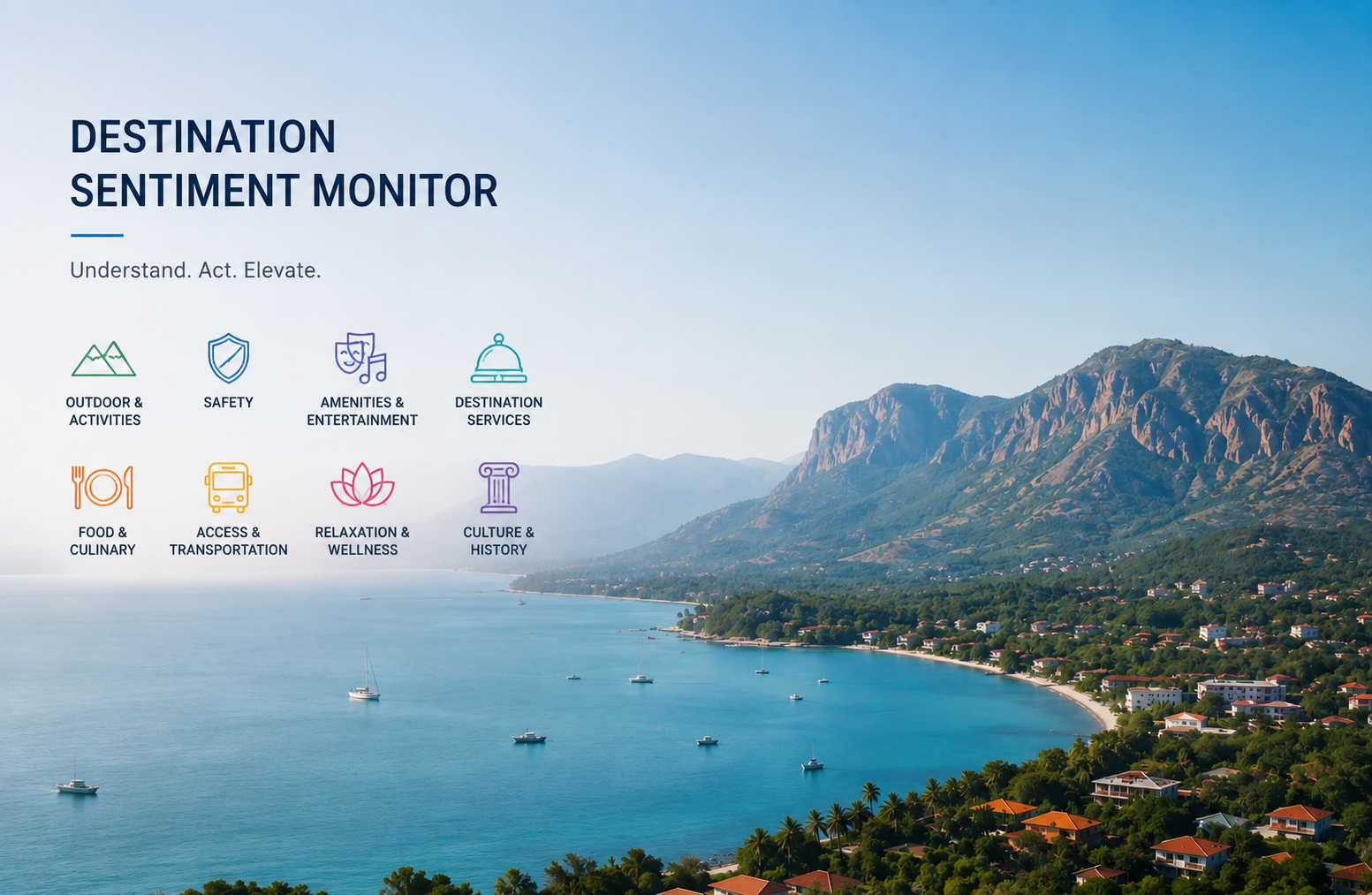
Our Destination Sentiment Monitor groups conversations into eight key areas that influence visitor perceptions.
Outdoor & Activities
Nature, adventure tourism, wildlife, parks, beaches, and outdoor recreation often shape a destination's image long before visitors arrive.
Safety
Traveler confidence is heavily influenced by perceptions of personal safety, cleanliness, health, and security.
Amenities & Entertainment
Shopping, nightlife, public spaces, events, and entertainment all contribute to the overall visitor experience.
Destination Services
Hotels, guides, tour operators, visitor centers, customer service, and hospitality standards all influence how visitors remember a destination.
Food & Culinary
For many travelers, food becomes one of the most memorable parts of any trip. Research has shown that culinary experiences are among the strongest drivers of positive destination sentiment, making local cuisine an increasingly important competitive advantage.
Access & Transportation
The ease of reaching a destination—and moving around once visitors arrive—plays a significant role in overall satisfaction.
Relaxation & Wellness
Beaches, wellness retreats, spas, and opportunities to unwind increasingly influence destination choice.
Culture & History
Historic sites, museums, festivals, architecture, traditions, and authentic local experiences help create emotional connections that travelers remember long after returning home.
Looking at these categories individually helps destination managers identify strengths, uncover weaknesses, and prioritize investment more effectively.
Awareness Isn't the Same as Reputation
One common mistake is assuming that the destinations generating the most online conversation are also the most successful.
They are not.
A destination may receive enormous attention because of a major sporting event—or because of a crisis.
Likewise, a smaller destination may generate fewer online conversations while consistently delivering exceptional visitor experiences.
Effective destination intelligence therefore considers two different questions.
First, are people talking about the destination?
Second, what are they actually saying?
Together, these two perspectives provide a much clearer understanding of destination performance than either could alone.
How DMOs Use a Destination Sentiment Monitor
For many destination organizations, sentiment monitoring has become an essential management tool rather than simply another marketing metric.
It provides early warning when perceptions begin to change, often before those changes appear in arrival statistics or visitor surveys.
It helps evaluate marketing campaigns by measuring whether public perception improved—not simply whether a campaign generated clicks or impressions.
It allows destinations to benchmark themselves against competitors, providing valuable context when setting marketing priorities.
Most importantly, it helps identify which parts of the visitor experience create lasting positive impressions and which areas deserve greater attention.
Destination managers can then make better-informed decisions about marketing, product development, visitor services, and long-term investment.
Cambodia: Looking Beyond the Headlines
Our live Cambodia Destination Sentiment Monitor demonstrates how reputation can be explored in far greater detail than a single overall measure.
Instead of simply asking whether perceptions are improving or declining, the dashboard highlights how travelers feel about different aspects of the destination. It shows where Cambodia is building a particularly strong reputation—such as its food and culinary experiences—and where perceptions continue to improve over time, including visitor confidence and safety.
This deeper level of insight allows destination managers to move beyond assumptions and make decisions based on evidence.
The same approach can be applied to countries, provinces, cities, or even individual tourism destinations around the world.
The Future of Destination Intelligence
The tourism industry has never had access to more information.
The challenge is no longer collecting data—it's turning that data into meaningful insight.
A Destination Sentiment Monitor helps destinations understand not simply how many people are visiting, but how people feel about the visitor experience and how those perceptions evolve over time.
Combined with visitor surveys, economic indicators, arrival statistics, and market research, sentiment monitoring provides a more complete picture of destination performance.
For forward-thinking destination organizations, measuring reputation is becoming as important as measuring arrivals.
Because in today's connected world, perception often shapes reality.
Frequently Asked Questions
What is a Destination Sentiment Monitor?
A Destination Sentiment Monitor continuously analyses publicly available online conversations to understand how travelers and the wider public perceive a destination.
Does it replace visitor surveys?
No. Visitor surveys and sentiment monitoring answer different questions. Surveys collect structured feedback from visitors, while sentiment monitoring observes naturally occurring conversations across digital channels. Together, they provide a more complete understanding of destination performance.
Why are neutral conversations important?
Most online discussions are neither strongly positive nor negative. These conversations provide valuable context and help create a more balanced picture of destination reputation.
Can sentiment monitoring identify problems early?
Yes. Changes in public perception often appear in online conversations before they become visible in visitor numbers or formal survey results, allowing destinations to respond more quickly.
How can a DMO use a Destination Sentiment Monitor?
DMOs use sentiment monitoring to evaluate marketing campaigns, benchmark competitors, monitor destination reputation, identify strengths and weaknesses across the visitor experience, and support evidence-based planning.