What Angkor's Quiet Means — and Why Cambodia Is Now in a Doom Loop
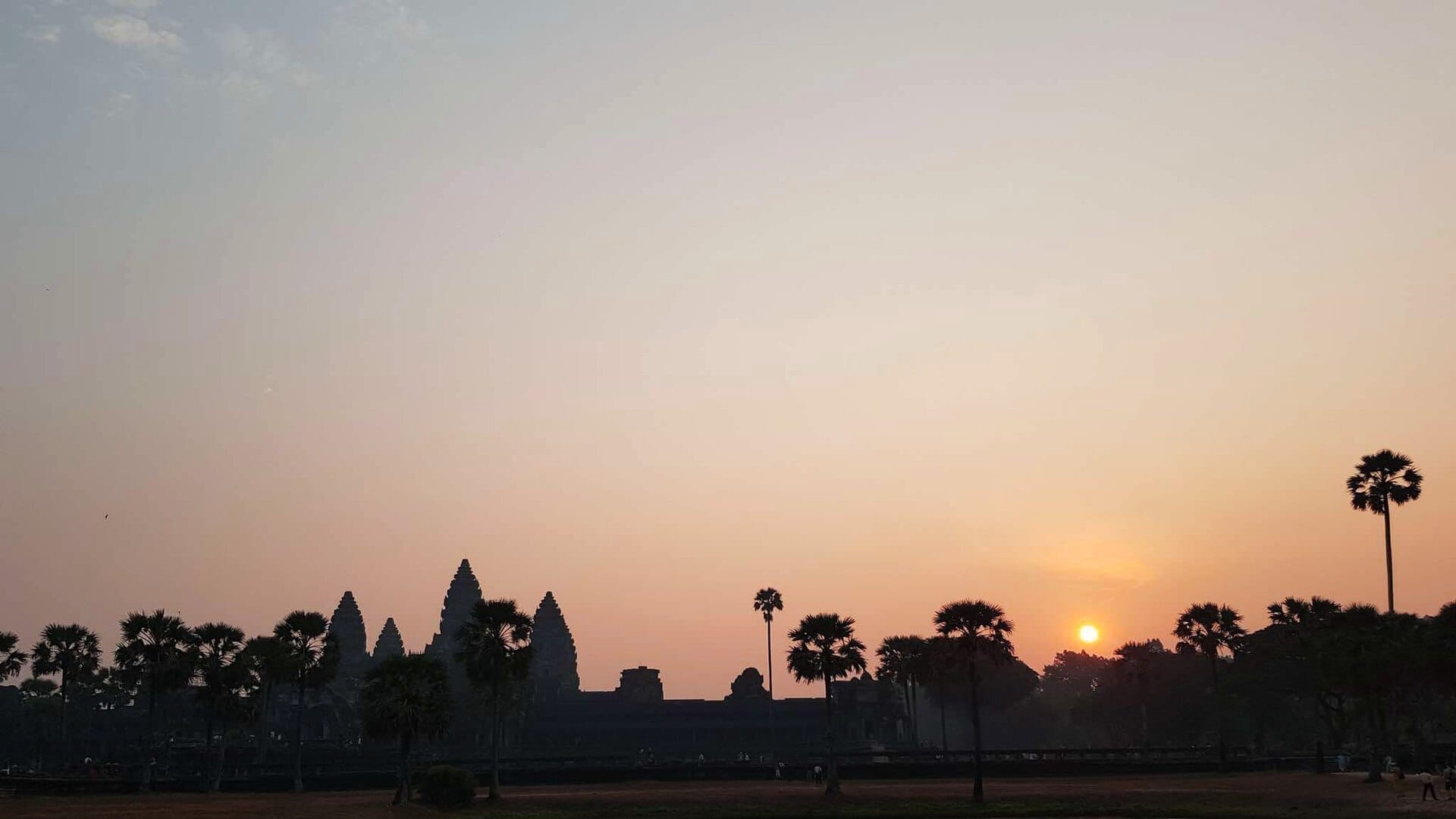
The most quoted image of Cambodia’s tourism crisis is the South China Morning Post’s: Angkor Wat, eerily quiet. Sunrise at the reflection pool with room to spare. Ta Prohm’s root-strangled corridors without the crush.
Destination Economics — Weekly Intelligence | Week of 19 September 2026
The most quoted image of Cambodia’s tourism crisis is the South China Morning Post’s: Angkor Wat, eerily quiet. Sunrise at the reflection pool with room to spare. Ta Prohm’s root-strangled corridors without the crush.
The image is emotionally powerful and analytically misleading—not because it is wrong, but because of what it leaves out.
The quiet is not evenly distributed across Cambodia. And where it is distributed tells you exactly what kind of crisis this is, who is still coming, and why the country is now at risk of a doom loop that gets harder to exit every quarter.
First, the Split: The Gateway Holds, the Attraction Empties
Look at the two datasets side by side:
National tourism: International arrivals fell roughly 46% in the first seven months of 2026—to about 1.99 million visitors. China (approximately 520,000, down 24%) and Vietnam (approximately 510,000, down 28%) contracted hardest.
Angkor Archaeological Park: Foreign visitors fell 29% from January through August, to 474,993. Ticket revenue declined 27.4%, to $22.54 million. Even August alone remained down 8% year on year.
At first glance, these figures appear to tell the same story. They do not.
If the national collapse were driven purely by fewer people flying to Cambodia, the park—the centerpiece of nearly every leisure itinerary—would be falling faster than the national number, not more slowly.
Read the gap the other way, and it reveals the composition of the collapse:
The trips being lost are overwhelmingly attraction-centered leisure trips. What remains is disproportionately travel that does not depend on Angkor: business travel, VFR (visiting friends and relatives), regional short stays, and destination-agnostic traffic concentrated in Phnom Penh.
That is why the gateway holds better than the attraction. Phnom Penh serves functions—government, garments, trade, and diaspora—that survive a leisure-demand shock. Siem Reap serves exactly one master, and that master stopped showing up.
Local reporting puts Siem Reap’s own visitor decline at more than 30%, with hundreds of restaurants, guesthouses, and hotels—some closed since COVID and never reopened—going dark again as the 2026 season fails to materialize.
There is even a counter-signal that sharpens the point: the coast is rising while Angkor cools. Tourism products around Sihanoukville and Kampot have quietly been gaining share, largely on domestic and regional demand.
Cambodian tourism demand did not vanish uniformly. It re-sorted. The destination-agnostic and domestic segments held; the single-asset temple circuit collapsed.
What a Gateway–Attraction Split Tells a Destination Manager
This split is one of the most diagnostic indicators in destination economics, yet almost nobody tracks it. Comparisons make the pattern easier to see:
Thailand, 2020–21
With borders closed, Bangkok held up better than Phuket or Chiang Mai because it retained a base of business, diplomatic, and repatriation traffic. When leisure returned, the leisure-heavy destinations rebounded hardest—but the gateway had never fallen as far.
Bali vs. Jakarta
A leisure island can lose 80% of its market while the capital’s hotels hold. When analysts said “Indonesia tourism is fine,” they were reading the gateway. The attraction had collapsed.
Egypt after 2015
Cairo’s business and transit base gave the country a floor. Luxor and the Red Sea leisure zones absorbed the full shock—and took years longer to recover because their recovery depended almost entirely on leisure demand returning.
Venice vs. Mestre
This is the classic gateway–attraction split in miniature: the mainland functions; the lagoon city lives on one industry.
Rule of thumb: When the attraction region falls faster than the gateway, the destination is losing the visitors with the highest spend per trip and the longest stays.
Leisure travelers on the temple circuit book three- or four-night stays in Siem Reap, hire guides, buy passes, and fill restaurants. A business traveler in Phnom Penh spends less per trip and purchases fewer peripheral services.
Cambodia’s national average-spend figures therefore flatter a much uglier reality on the ground in Siem Reap.
Now the Doom Loop
This is where this week’s data turns the analysis darker.
Arrivals in early September have fallen further. The decline is accelerating, not stabilizing. That tips Cambodia from a downturn into the mechanics of a doom loop.
1. Revenue falls → marketing and product budgets are cut
Margins for Siem Reap’s hotels and operators are already gone. The first casualty is overseas marketing.
Fewer campaigns lead to fewer bookings, which produce still less revenue.
2. Capacity quietly exits
Hotels close or sell. Reporting already shows widespread closures, including properties that shut during COVID and never reopened. Restaurants go dark.
As staff disperse to Phnom Penh, Thailand, or other industries, service quality—the thing a destination sells—degrades physically, not just in perception.
3. Perception compounds the shock
The scam-center reputation and the Thailand border conflict are not one-time hits. They are standing negatives in every potential visitor’s research.
Travel advisories, media coverage—“eerily quiet” becomes “why is no one going to Angkor?”—and personal anecdotes create a perception loop that outlasts the underlying facts.
4. Access follows demand
Airlines protect load factors by reallocating aircraft. Every month of soft Siem Reap-bound demand makes the city’s nine international routes harder to defend. Seat capacity is the one thing that can take a year to rebuild.
This is where the loop becomes self-fulfilling:
Demand falls → capacity is withdrawn → prices rise → demand falls further.
5. The asset loses its economics
Angkor’s ticket revenue funds conservation. A 27–30% revenue cut creates a conservation and product-maintenance problem with a multi-year lag.
A destination that under-maintains its hero asset has weakened its core product just when it needs it most.
Each loop is survivable. Five interlocking loops, mutually reinforcing and combined with a standing reputational negative, constitute a doom loop.
The cost of exiting rises with every quarter it continues.
Breaking the Loop: The Sequence That Works
Historical examples show what actually breaks a tourism doom loop—and it is never a single campaign.
Egypt: Repair perception first
Egypt recovered by addressing the perception problem first through concerted safety messaging and high-profile state visits to Luxor. It then restored airlift and product.
Perception comes first. Marketing expenditure made before perception repair is largely wasted.
Thailand and Sri Lanka: Protect one anchor market
Thailand after the 2014 coup and Sri Lanka after 2019 both recovered through aggressive, price-led efforts focused on a single anchor source market.
They accepted margin pressure to keep aircraft and staff in place, buying time for perception to normalize.
Vietnam: The counterfactual
Vietnam today provides the regional counterfactual: similar geography, comparable Chinese visa relaxation, and Chinese arrivals up 16%—because its perception loop is working in its favor rather than against it.
For Cambodia, the sequence is uncomfortable but clear:
- Repair the scam-center perception through verifiable, third-party-validated action before spending heavily on demand generation.
- Keep Siem Reap’s physical capacity and trained staff in place through the trough.
- Negotiate air capacity while schedules remain intact—the one advantage that will not last indefinitely.
- Stop treating the national arrival figure as the primary health metric. The Angkor number is the real patient.
The Takeaway
“Angkor is quiet” is not a color piece. It is the single most important data point in Cambodian tourism right now.
A destination whose attraction region empties while its gateway holds is losing its highest-value demand—and every week of delay raises the cost of recovery.
The planes are still flying. But if the doom loop reaches the route map, they will stop.
Sources: Angkor Enterprise and Ministry of Tourism statements reported by Xinhua and Khmer Times; South China Morning Post; Travel and Tour World; Cambodianess; Ministry of Tourism arrivals data, January–July 2026.