The Planes Are Still Flying. The Passengers Stopped Booking
Cambodia’s international arrivals are down 46% in the first seven months of 2026, falling to approximately 1.99 million visitors. China, at roughly 520,000 arrivals, is down 24%. Vietnam, at roughly 510,000, is down 28%.
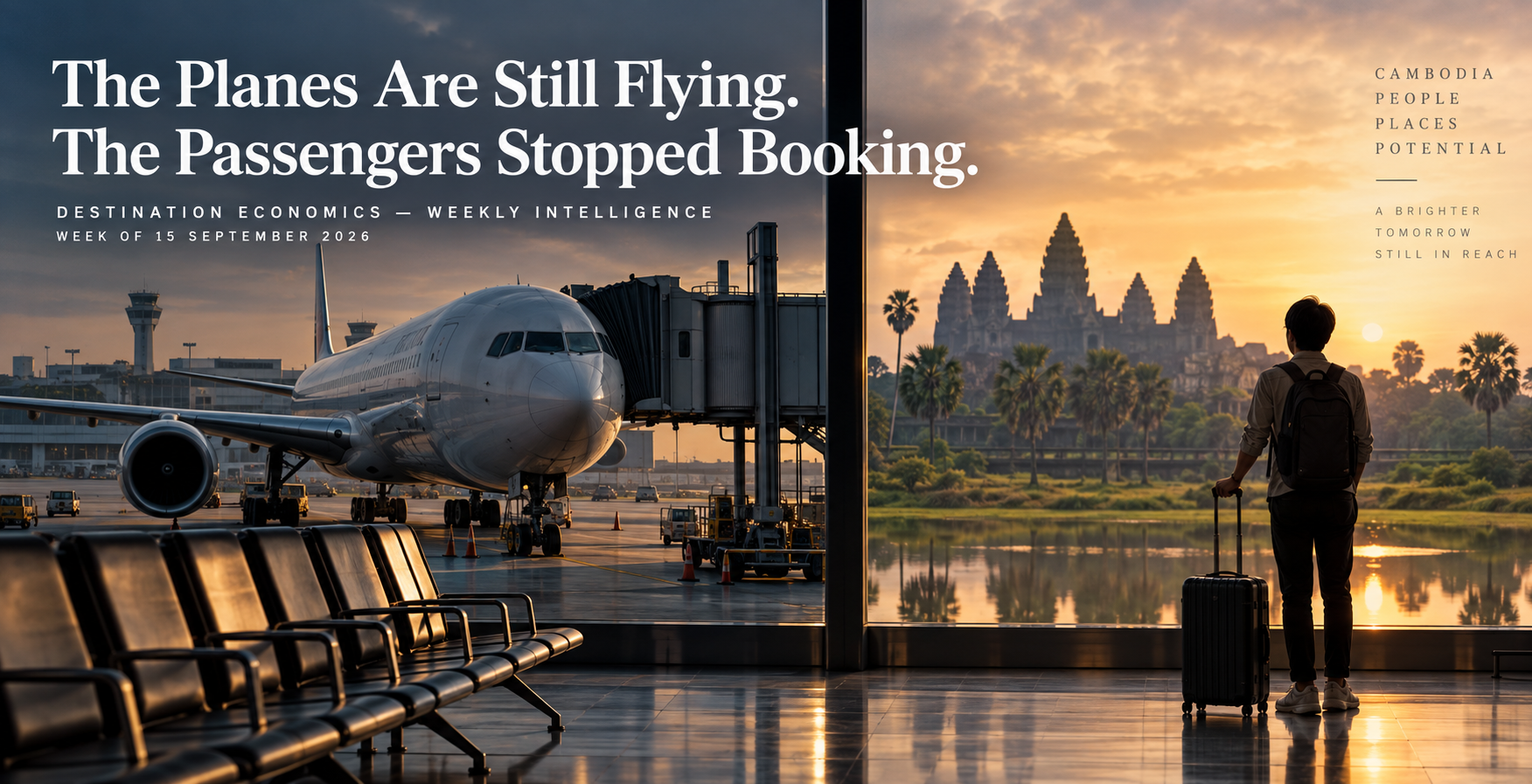
Destination Economics — Weekly Intelligence | Week of 15 September 2026
Cambodia’s international arrivals are down 46% in the first seven months of 2026, falling to approximately 1.99 million visitors. China, at roughly 520,000 arrivals, is down 24%. Vietnam, at roughly 510,000, is down 28%.
Those numbers have been reported, re-reported, and worried over.
But there is a more useful question:
What kind of tourism problem does Cambodia actually have?
The answer matters because a supply-side crisis and a demand-side crisis have very different causes, require very different responses and — most importantly — have different owners.
The data says capacity held. Demand collapsed.
The clearest signal is the divergence between visitor arrivals and airline capacity.
Weekly schedule tracking shows Cambodia’s international air network holding at approximately 33 unique international routes: 22 into Phnom Penh, nine into Siem Reap and two into Sihanoukville, operated by roughly 28 carriers.
That network has remained remarkably stable through the same period in which Cambodia’s arrival numbers were falling sharply.
If Cambodia were experiencing a classic supply-side crisis — essentially, an access problem — we would expect to see the second-order effects quickly:
- Airlines cancelling routes.
- Frequencies being reduced.
- Seats being withdrawn.
- Carriers reallocating aircraft to stronger markets.
That is what an air-access collapse looks like.
It is not what the current data shows.
The seats are still being flown. The passengers stopped booking.
That is the signature of a demand-side crisis.
Supply-side vs. demand-side: why the distinction matters
WHAT BROKE?
Supply-side crisis: Access breaks — routes are cut and airlines leave.
Cambodia in 2026: Demand broke — bookings fell while airline capacity remained.
WHO OWNS THE FIX?
Supply-side crisis: Governments, airports and airlines.
Cambodia in 2026: DMOs, hotels, operators and government — the organizations that can influence demand.
WHAT ARE THE TOOLS?
Supply-side crisis: Route incentives, subsidies and airport agreements.
Cambodia in 2026: Source-market campaigns, competitive packages, pricing, promotions and reputation management.
HOW FAST CAN IT CHANGE?
Supply-side crisis: Think years. Airline network decisions and route development move slowly.
Cambodia in 2026: Think months. Campaigns, packages, pricing and market positioning can move much faster.
That distinction changes the strategy. Cambodia does not primarily need to rebuild access. It needs to rebuild the reasons to book.
Why this is good news buried inside bad news
A supply-side crisis is difficult for the tourism industry to solve on its own. Hotels and operators cannot manufacture international routes. They have to wait for governments, airports and airlines to negotiate capacity back into the market.
A demand-side crisis is different.
It is painful, but it is also the kind of crisis the tourism industry can influence directly.
And soft demand creates several temporary advantages.
Air capacity becomes negotiable
Stable schedules combined with weak bookings mean airlines have inventory to fill. Campaign fares, cooperative marketing, tactical promotions and charter discussions all become more realistic when carriers need help stimulating load factors.
Hotel inventory becomes negotiable
The same principle applies on the ground. Softer occupancy creates room for tactical packages, added-value offers and competitive allotments that become harder to secure once demand recovers.
Source-market share becomes contestable
Travel demand did not disappear from Southeast Asia.
It moved.
And one of the most important battles is being fought over the Chinese outbound traveler.
The China problem: increasingly, this is about value
Cambodia has already moved on one important barrier: access.
A pilot visa-free scheme allows ordinary Chinese passport holders to visit for up to 14 days, with the current pilot scheduled to expire on 15 October 2026.
Yet removing the visa barrier has not produced a return to previous demand levels.
One recurring theme in Chinese travel discussion is increasingly difficult to ignore: price-value perception.
The complaints are often highly specific. Restaurant prices. Tuk-tuk quotes. Transfers. Angkor-area tour pricing. The cumulative feeling that Cambodia no longer delivers the same value proposition as competing destinations in the region.
That matters because Cambodia is not competing against an abstract idea of Southeast Asia. It is competing against real itineraries that travelers can price in seconds.
Vietnam is especially important in this comparison. Chinese travelers reconsidering Thailand and other regional destinations are actively looking at alternatives, and Vietnam is capturing growing attention through a combination of accessibility, product variety and perceived value.
Chinese outbound travel itself is recovering. The contest is therefore not simply about whether Chinese travelers will travel.
The contest is about where they will go.
Cambodia’s challenge is that its price positioning may have drifted above the value travelers believe they are receiving.
That is not a geographic inevitability. It is a market problem — and market problems can be fixed.
What the private sector can do now
1. Fix price-value delivery, not simply price levels
A US$12 meal can feel like a rip-off or a bargain depending on what arrives at the table.
The issue is not that every tourism business needs to become cheaper. It is that the experience must visibly justify the price.
Operators should publish realistic price guides, make inclusions obvious, standardize common transport pricing where possible, and remove the “tourist price” surprises that generate damaging complaint posts.
2. Attack the package economics
Chinese travelers increasingly compare trips through OTAs, social platforms and travel apps where competing itineraries sit side by side.
Cambodian suppliers should deliberately build four- and five-day Siem Reap and Phnom Penh packages and benchmark them against equivalent Vietnam itineraries.
Not approximately. Not emotionally.
Line by line.
Airfare, hotels, transfers, attractions, meals and activities all form part of the traveler’s final perception of value.
3. Go where the complaint is happening
The conversation is not taking place primarily in English-language press releases.
It is taking place on Chinese booking platforms, review sites, Xiaohongshu, WeChat travel communities and other digital channels where travelers research destinations and validate purchasing decisions.
Businesses that monitor those conversations and respond with transparent pricing and credible offers are doing demand generation.
Businesses that ignore them are allowing somebody else to define Cambodia’s value proposition.
What government can do
1. Turn the visa experiment into a market signal
If the current visa-free pilot performs, Cambodia should consider making the arrangement longer-term and communicate it far more aggressively.
The pilot window expiring on 15 October is useful only if the intended market knows it exists.
The message should be distributed in Chinese, through Chinese channels, and attached to a clear value proposition rather than presented as an administrative announcement.
2. Coordinate a price-transparency campaign
Publish indicative price ranges for the transactions almost every visitor encounters:
- Airport transfers.
- Tuk-tuk journeys.
- Angkor day tours.
- Phnom Penh sightseeing days.
- Common meal brackets.
- Guide and transport combinations.
An official benchmark will not eliminate overcharging. But it changes the information balance and makes abusive pricing easier for travelers, platforms and authorities to identify.
3. Negotiate with airlines while demand is soft
Stable capacity combined with weaker demand creates a useful negotiating window.
Rather than subsidizing routes indefinitely, government and tourism stakeholders can pursue time-limited joint marketing campaigns with carriers serving priority Chinese cities.
The goal should be to stimulate bookings, improve load factors and restore momentum while the inventory is available.
4. Fix the economics of the Angkor experience
Angkor remains the Cambodian product with the strongest international recognition.
That makes every friction point around the experience disproportionately important.
High transport costs into Siem Reap, combined with inconsistent local pricing or reports of overcharging, create a double cost penalty around the destination’s flagship attraction.
This requires enforcement and commercial coordination, not another slogan.
Where reputation management fits
There is an uncomfortable connection between the cost problem and the reputation problem:
They are often the same problem.
When a traveler writes, “The fried rice cost me far more than it should have,” the traveler is not merely reporting a price.
They are reporting a perceived breach of fairness.
Price complaints are trust complaints with a receipt attached.
And trust is the currency that destination reputation management ultimately protects.
This is why reputation management cannot sit on top of a recovery strategy as a piece of “brand halo” spending. It needs to operate as part of the demand-recovery engine itself.
Monitor where booking decisions are made
Recovery will be won or lost on review sites, OTAs, social platforms, travel forums and messaging communities — not through press releases alone.
Continuous review aggregation can reveal what travelers actually believe about Cambodia week by week rather than waiting for an annual survey to identify a problem everybody online already knows about.
Close the complaint loop
Every unanswered scam or overcharging story can become somebody else’s reason not to book.
A coordinated respond-and-resolve process turns reputation management into a commercial function:
Listen → Respond → Resolve → Demonstrate improvement.
Measure the perception gap
One of Cambodia’s underused assets is that the actual visitor experience is often stronger than the negative narrative surrounding the destination.
Hotel ratings across major platforms frequently sit well above four out of five, while Cambodia continues to generate strong reviews around food, hospitality, heritage and cultural experiences.
The important metric is therefore not simply “positive versus negative sentiment.”
It is the gap between what recent visitors experience and what potential visitors believe before they book.
Track that gap weekly and reputation management becomes measurable.
Protect the recovery once it begins
There is another risk.
When demand returns, pricing discipline can disappear quickly. Capacity tightens. Operators raise prices. Opportunistic pricing returns.
A destination that rebuilds demand without building a reputation-management system can end up recreating the same problem two years later.
The sequencing is therefore important:
In a demand-side crisis, reputation management is not something to fund after recovery. It is part of the mechanism that creates recovery.
The window is open — but it will not stay open
Demand-side crises do not announce when the opportunity to correct them is about to disappear.
Cambodia has stable international air capacity today. That means airlines still need passengers. Hotels still need occupancy. Operators still need volume.
Every week of soft demand creates negotiable inventory:
- Airfares that can be promoted.
- Hotel allotments that can be packaged.
- Cooperative marketing funds that can be negotiated.
- Source markets whose loyalties are still in play.
Those conditions become less favorable once recovery is obvious.
The industry therefore does not need to wait for a plan describing what to do after demand recovers.
It needs to start the recovery.
And the tools are already available:
- Better price-value delivery.
- Competitive source-market packages.
- Chinese-market distribution and communication.
- Airline partnerships.
- Transparent pricing.
- Fast complaint resolution.
- A reputation infrastructure built around trust.
Waiting for the next official arrivals release to confirm what the operating data is already showing may be the most expensive option on the table.
By the time the statistics fully document the divergence, much of the commercial window may already be gone.
Track Cambodia's tourism market weekly
Destination Economics tracks Cambodia’s airlift, tourism sentiment and destination reputation weekly.
Explore the Cambodia Airlift Monitor and Cambodia Sentiment Monitor.
The underlying intelligence and expanded analysis are available through Destination Economics and the DestinationPro subscription.