When Conflict Redraws the Tourism Map: The Perception Gap That Decides Recovery
Discover how war and conflict reshape tourism, influencing perceptions and guiding destinations to brand themselves as safe havens.

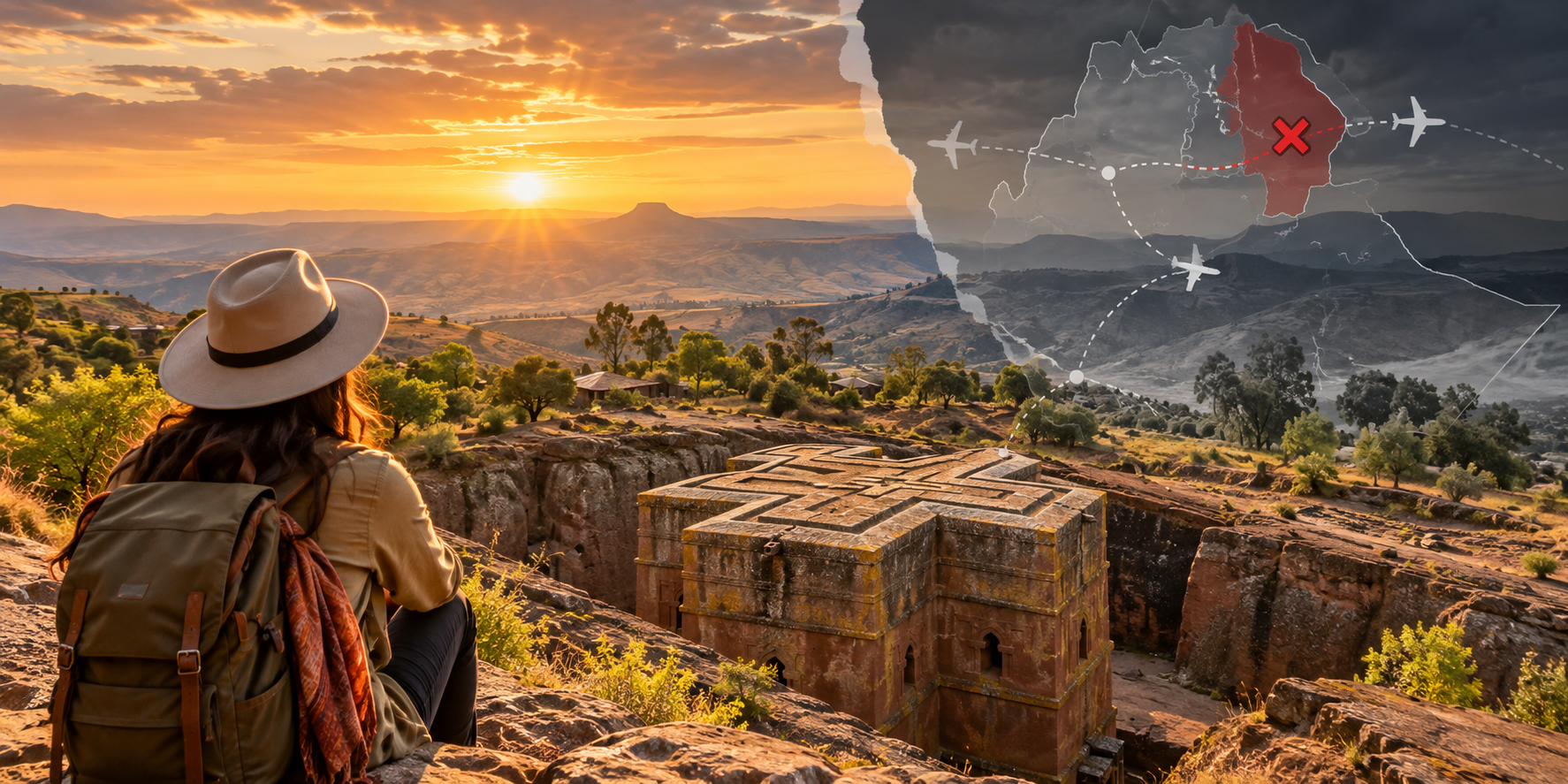
Changing Preferences for Safe and Secure Destinations
War and political conflict have always rerouted travel. What has changed is the speed at which perceptions now move — and how quickly a localized security problem can become a national tourism problem.
Ethiopia offers a particularly timely example.
The country is confronting one of the most difficult challenges in destination management: the gap between where the risk actually exists and where prospective travelers believe it exists.
For destination planners, tourism authorities and operators, narrowing that gap is not simply a communications exercise. It is part of managing the destination itself.
The Historical Pattern: Travelers Vote With Their Feet
Conflict has been reshaping tourism flows for generations.
Wars in Europe redirected international travel. Conflict in Southeast Asia changed regional travel patterns. Repeated instability in parts of the Middle East has shifted demand toward destinations perceived as safer and more predictable.
In each case, destinations outside the conflict zone benefited — sometimes without changing their product at all. Their competitive advantage was simply that travelers believed they offered greater stability.
The pattern is familiar. What is different today is the speed at which perceptions form.
News alerts, government advisories, airline cancellations, TikTok videos, Reddit discussions and WhatsApp messages can reshape a destination's image within hours. Years of destination branding can suddenly be competing against a handful of images from a conflict hundreds of kilometers away from the country's principal tourism areas.
And once that perception takes hold, it can be remarkably difficult to reverse.
How Safety Perceptions Form — and Why They Lag Reality
In our experience, three forces have an outsized influence on how travelers interpret destination safety.
Government travel advisories are perhaps the most powerful. Travelers read them, but so do insurers, tour operators, corporate travel managers and travel agents. A change in advisory status can therefore affect far more than individual traveller confidence; it can influence whether a trip can be insured, sold or approved at all.
Media coverage is the second force. Conflict is newsworthy, but geography rarely fits neatly into a headline. A serious incident in one region can quickly become a story about the country as a whole.
Social proof is increasingly the third force. Travelers now consult friends, family, online reviews, Reddit discussions, YouTube and TikTok alongside traditional travel media. A visitor posting from a café, hotel or heritage site can sometimes influence perceptions as much as an official tourism campaign.
The difficult part is that perception tends to form quickly and fade slowly.
A security situation can improve in weeks. The destination's reputation may take months — or years — to catch up.
That lag between conditions on the ground and conditions in the traveler's mind is the perception gap.
Ethiopia in 2026: A Live Case Study
Ethiopia demonstrates why this distinction matters.
From a tourism-product perspective, the country remains extraordinarily strong. Its cultural and historical assets include Lalibela, Axum and Gondar, while Addis Ababa functions as one of Africa's most important aviation gateways.
Recent tourism figures also point to considerable underlying demand. Ethiopia's Ministry of Tourism reported more than 1.6 million international visitors and over US$5 billion in tourism revenue during the recently completed Ethiopian fiscal year.
Then the security picture changed.
Renewed fighting in northern Ethiopia in September led Ethiopian Airlines to suspend flights to Mekelle, Axum and Shire. Access to northern tourism areas has consequently become a serious operational issue, while governments have reiterated or strengthened warnings concerning travel to affected regions.
That distinction matters.
The security risk is serious, but it is not geographically uniform. Addis Ababa, for example, has remained comparatively calm while conditions in parts of northern Ethiopia have deteriorated sharply.
Travelers, however, do not necessarily process risk geographically.
They see Ethiopia in the headline.
That is where a regional security crisis can become a national tourism crisis.
The Product Can Be Strong While the Destination Brand Weakens
This is an important lesson for destination managers.
A destination can simultaneously have excellent hotels, extraordinary cultural attractions, strong aviation connectivity and satisfied visitors — and still lose bookings because safety overwhelms every other consideration.
Our Destination Economics monitoring illustrates this clearly.
Ethiopia continues to perform well across important elements of the visitor experience, particularly amenities, accommodation and cultural assets. Yet our Safety measure has fallen into the caution range, while the Destination Net Sentiment Score declined from +32 to +24 during the week ending 27 September 2026.
The tourism product did not suddenly become eight points worse.
The context surrounding the product changed.
This distinction is essential because it determines the response.
Why Marketing Is Not the First Move
The natural instinct when demand falls is to launch a campaign.
“Ethiopia is open.”
But that is not necessarily the message travelers need.
Marketing cannot outrun unresolved operational problems. If airports are suspended, roads are uncertain, insurance coverage is affected or travelers cannot determine which areas are accessible, a reassurance campaign can actually damage credibility.
The first responsibility is not promotion.
It is clarity.
1. Segment the map
Stop communicating about the destination as though every region is experiencing identical conditions.
Identify what is open, what is operating normally, what requires caution and what should currently be avoided.
Then build itineraries around areas that can be delivered reliably and responsibly.
Destination authorities should be able to answer one basic traveler question quickly:
“Where can I safely and realistically travel today?”
2. Close the information gap
This is where destination management becomes operational rather than promotional.
Tour operators, hotels, guides, airlines and tourism authorities need access to the same current information.
If an attraction is being sold while its normal access route is suspended, the problem is no longer simply logistical. It becomes a credibility issue.
A destination facing rapidly changing conditions should maintain a single authoritative source showing airport status, road access, affected tourism areas and significant changes to visitor operations.
The trade should be able to use it. Travelers should be able to understand it.
And it must be updated continuously.
3. Reduce the traveler's booking risk
One of the less visible consequences of political instability is what happens between inspiration and purchase.
Travel insurance may become more difficult or expensive. Operators may hesitate to confirm departures. Travelers may worry about losing deposits.
Destinations and tourism businesses therefore need to think beyond reassurance.
Flexible booking conditions, transparent cancellation policies, realistic alternative itineraries and close engagement with insurers and international tour operators can all help reduce the financial risk of saying yes.
Sometimes the biggest obstacle to travel is not fear of the destination.
It is fear of losing the money already paid for the trip.
4. Rebuild perception market by market
Not every traveler responds to risk in the same way.
Experienced cultural travelers, diaspora visitors, repeat visitors and some specialist adventure segments often understand regional geography better than first-time leisure travelers.
These audiences can therefore be important early-recovery markets.
But credibility matters.
Rather than simply telling audiences that a destination is safe, show them what is happening in the areas where tourism is operating normally.
Current visitor experiences, independent journalists, respected travel professionals and credible creators can provide evidence that conventional advertising cannot.
The objective is not to minimize genuine risk.
It is to make the geography of that risk understandable.
5. Measure the perception gap
Destination recovery should be measured, not guessed.
Track traveler sentiment alongside airline capacity, hotel performance, search behavior, booking activity, government advisories and media coverage.
In Ethiopia's case, the movement in our Net Sentiment Score from +32 to +24 provides a useful signal.
The number itself is less important than the direction.
If sentiment begins recovering while air access, visitor reviews and operating conditions remain stable, the destination can gradually move from crisis communication toward active market rebuilding.
If sentiment continues falling, increasing advertising spend is unlikely to solve the underlying problem.
Lessons for Every Destination
Ethiopia may be the current example, but the lesson is much broader.
Treat safety perception as destination infrastructure. Reputation is not separate from the tourism product. In practical terms, perceptions of safety can influence demand just as directly as airline seats, hotel inventory and visa policy.
Communicate geographically. Where risk is genuinely localised, destinations should provide the clearest possible regional information and encourage source-market governments to make their advisories geographically precise where conditions justify it.
Prepare before the crisis. Airports, tourism ministries, DMOs, hotels and tour operators should know who communicates what before an incident occurs. The first days of a crisis are not the time to begin designing the information chain.
Connect operations with communications. Marketing teams cannot be telling travelers one story while operators, airlines and government agencies are communicating another.
Never confuse reassurance with transparency. Travelers do not expect destinations to be risk-free. They do expect them to be credible.
That credibility becomes one of the destination's most valuable assets during recovery.
The Bottom Line
Conflict will continue to reshape tourism flows.
Some destinations will lose visitors because the actual risk has become unacceptable. Others will lose visitors because geographically limited risks become associated with the destination as a whole.
Understanding the difference is one of the central challenges of modern destination management.
Ethiopia has substantial tourism fundamentals: extraordinary cultural heritage, an internationally connected aviation hub, improving tourism performance and a product capable of attracting cultural, adventure, diaspora and specialist travelers.
But those strengths cannot simply be marketed over a security crisis.
The immediate task is more disciplined: identify the risk accurately, communicate it geographically, protect the traveler, keep the trade informed and measure how perceptions change.
When conditions improve, marketing can accelerate recovery.
Until then, credibility is the campaign.
Destination Economics analysis in this article draws on the Ethiopia Destination Sentiment Monitor, Airlift & Connectivity Monitor and Reputation Context profiles, with monitoring through 27 September 2026. Security conditions and transport operations can change rapidly; travelers and tourism businesses should consult current government advisories and airline information before making travel decisions.
The tourism perception gap is the difference between the actual level and geographic extent of risk within a destination and the level of risk travellers believe exists. During conflict or political instability, localized disruption can become associated with an entire country, affecting bookings even in tourism areas operating normally.