Top 10 Tourism Data Mistakes DMOs Make
Tourism decisions are often based on historical reports, fragmented datasets, or assumptions rather than evidence. The result is missed opportunities, inefficient marketing, and weaker investment decisions.

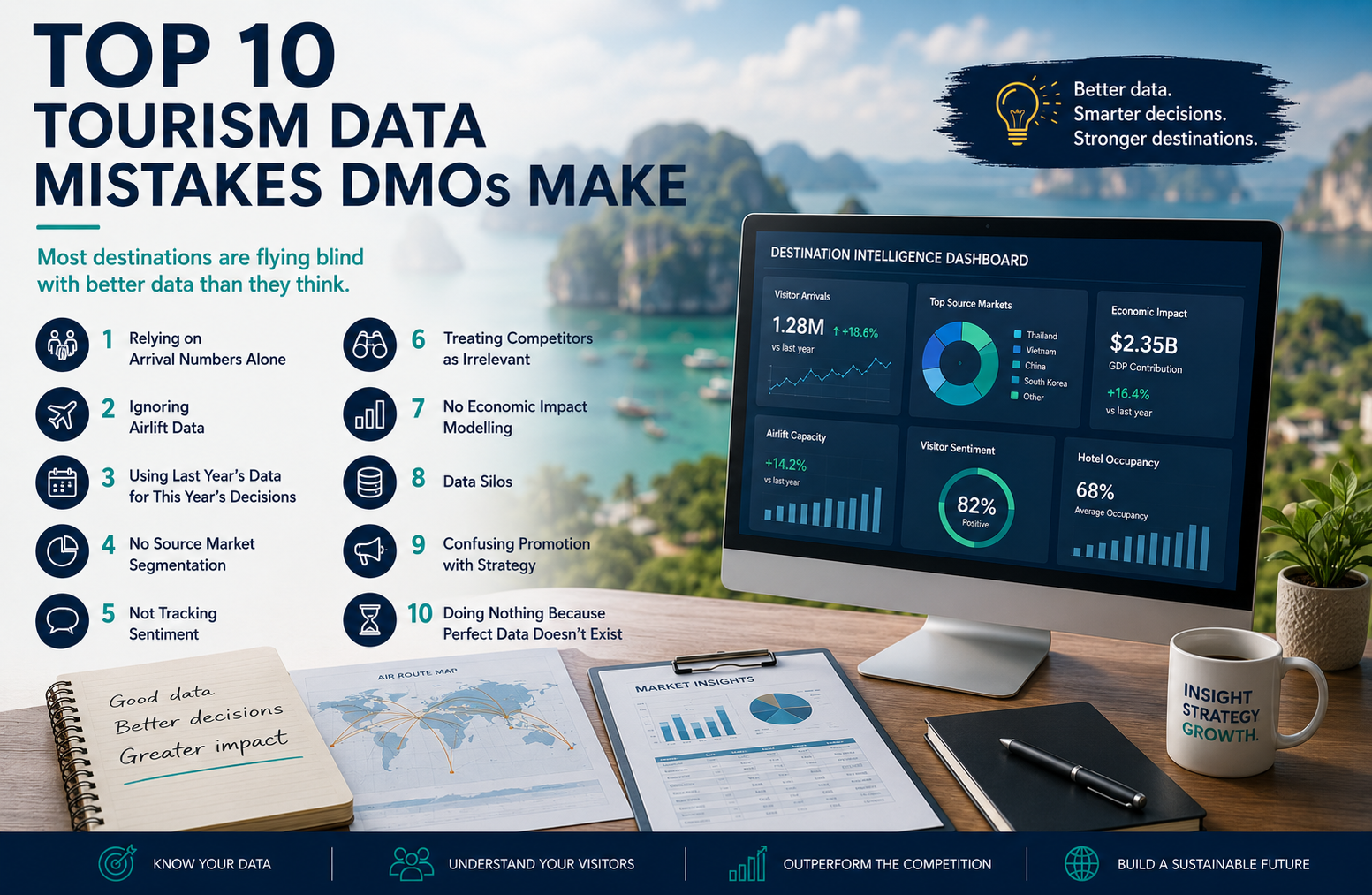
Most destinations are flying blind with better data than they think.
Every destination collects data.
The problem is that very few destinations use it effectively.
Tourism decisions are often based on historical reports, fragmented datasets, or assumptions rather than evidence. The result is missed opportunities, inefficient marketing, and weaker investment decisions.
Here are the ten most common mistakes we see.
1. Relying on Arrival Numbers Alone
Arrival figures measure volume, not value.
Two destinations can welcome exactly the same number of visitors while producing dramatically different economic outcomes. One may attract high-spending, long-stay travellers, while the other relies on low-spending day visitors.
Successful destinations focus on visitor value, not simply visitor numbers.
2. Ignoring Airlift Data
Tourism cannot grow without airline capacity.
Yet many DMOs have little visibility into:
- Airline seat capacity
- Route performance
- Competitor air connectivity
- Emerging route opportunities
Airlines expand where demand is proven. If you cannot demonstrate demand with data, they will invest elsewhere.
3. Using Last Year's Data for This Year's Decisions
Tourism changes rapidly.
In a single year:
- New airline routes appear
- Source markets shift
- Visa policies change
- Exchange rates fluctuate
- Competitors launch new campaigns
A report that's twelve months old may already be outdated.
Near real-time intelligence has become essential.
4. No Source Market Segmentation
"International arrivals increased by 8%."
That sounds impressive—until you discover all the growth came from a single low-yield market.
Without segmentation, destinations often celebrate statistics that hide deeper structural problems.
Know who is arriving—not just how many.
5. Not Tracking Visitor Sentiment
Official statistics explain what happened.
Sentiment analysis explains why.
Social media, online reviews, travel forums, and digital conversations provide early warning signals long before traditional surveys are published.
Monitoring visitor perception is now a critical management tool.
6. Treating Competitors as Irrelevant
Destinations do not compete in isolation.
Airlines, tour operators, investors, and travellers compare destinations every day.
Track competitor activity such as:
- New airline routes
- Marketing campaigns
- Infrastructure investment
- Visa reforms
- Tourism policies
Without competitor intelligence, planning becomes guesswork.
7. No Economic Impact Modelling
A common question from governments is:
"What is tourism worth to our economy?"
Surprisingly, many destinations cannot answer confidently.
Economic impact modelling demonstrates:
- GDP contribution
- Employment generation
- Tax revenue
- Investment returns
- Economic multipliers
Without these figures, tourism often loses funding to sectors with stronger evidence.
8. Keeping Data in Silos
Important tourism information is usually scattered.
- Immigration holds arrival data.
- Airports hold aviation data.
- Hotels track occupancy.
- Tourism boards conduct surveys.
- Private businesses collect visitor insights.
Individually these datasets have value.
Combined, they tell the complete story.
9. Confusing Promotion with Strategy
Marketing is not strategy.
Running advertising campaigns before understanding:
- Source markets
- Competitive positioning
- Product gaps
- Visitor behaviour
is simply spending money without diagnosing the real problem.
Strategy should always come before promotion.
10. Waiting for Perfect Data
Perfect tourism data does not exist.
The most successful destinations begin with the information already available:
- Arrival trends
- Air connectivity
- Hotel performance
- Visitor sentiment
- Market intelligence
Good decisions made today outperform perfect decisions that never happen.
The Solution
Every destination has more data available than it uses.
The challenge is rarely access to information.
The challenge is turning disconnected datasets into meaningful intelligence.
At Destination Economics, we combine tourism statistics, aviation data, visitor sentiment, market trends, and economic analysis into practical insights that support better decision-making.
Instead of overwhelming you with spreadsheets, we help you understand what the data actually means—and what to do next.
Ready to Make Better Tourism Decisions?
Whether you need a market intelligence report, destination strategy, economic impact assessment, or ongoing tourism analytics, we're here to help.