What Is Destination Intelligence? A Complete Guide for DMOs & Tourism Boards
Destination Intelligence helps tourism organizations move from collecting data to making better decisions.

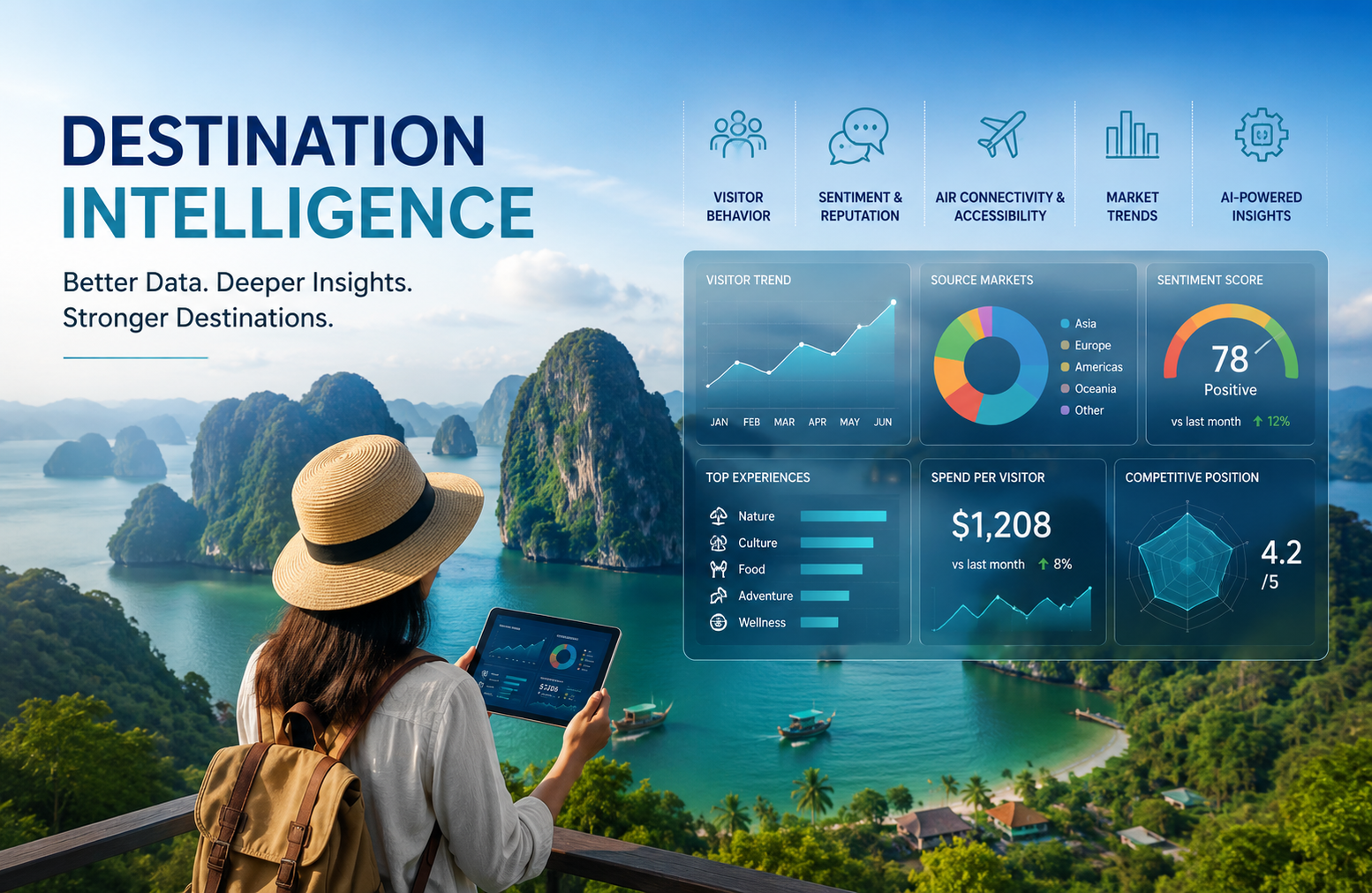
Destination Intelligence helps tourism organizations move from collecting data to making better decisions.
Tourism generates enormous amounts of information: visitor arrivals, hotel occupancy, spending, airline capacity, reviews, search behavior, social conversations, booking patterns and market trends.
The challenge is no longer simply finding data.
The challenge is understanding what it means — and deciding what to do with it.
That is where Destination Intelligence comes in.
What Is Destination Intelligence?
Destination Intelligence is the collection, analysis and interpretation of tourism information to support better destination decisions.
It combines traditional tourism statistics with wider market and behavioral intelligence, including:
- visitor arrivals and expenditure
- source-market trends
- traveler behavior
- air connectivity and accessibility
- destination reputation and sentiment
- competitive benchmarking
- tourism economics
- search and digital signals
- product and experience trends
- AI-supported analysis
The objective is not to create more reports.
It is to help tourism leaders understand what is happening, why it is happening and what they should do next.
Tourism Statistics Tell You What Happened
Traditional tourism statistics remain essential.
Arrivals, occupancy, length of stay, visitor expenditure and source-market data provide the foundation for destination management.
But statistics alone rarely tell the full story.
Suppose international arrivals decline by 8%.
That number tells you there is a problem. It does not necessarily tell you why.
Was air capacity reduced?
Did fares increase?
Did visa requirements change?
Has traveler sentiment weakened?
Is a competitor attracting more attention?
Has demand shifted toward different experiences?
Destination Intelligence connects those signals.
Instead of asking only:
“How many visitors came?”
destination managers can begin asking:
“Why did they come, what did they do, how did they feel about the experience, and what is changing in the market?”
That is the difference between reporting and intelligence.
From Dashboard to Decision
Tourism organizations have invested heavily in dashboards.
Dashboards are useful because they organize information and make trends easier to see.
But seeing information is not the same as knowing what to do with it.
Consider the difference.
A dashboard might report:
Visitor sentiment declined this month.
Destination Intelligence goes further:
Sentiment declined primarily because visitors were discussing transportation problems and congestion. The decline is concentrated among independent travelers from two important source markets.
That second level of information gives a destination something it can investigate and act upon.
Good Destination Intelligence should ultimately answer one practical question:
What decision does this information help us make?
Understanding Visitor Behavior
One of the most important developments in tourism intelligence is the shift from counting visitors to understanding them.
Destinations increasingly need to understand:
- why travelers chose the destination
- which experiences influenced their decision
- what they searched for before traveling
- which places they visited
- how long they stayed
- what they spent money on
- what frustrated them
- what they recommended
- what they are saying online
- what they may be interested in next
This matters because modern travelers increasingly choose trips around experiences rather than simply famous destinations.
Food, culture, nature, wellness, events, adventure and lesser-known places can all influence travel decisions.
For destination managers, understanding these interests creates opportunities to develop new products, attract different markets and spread tourism benefits beyond established visitor areas.
Destination Reputation Is Part of the Intelligence Picture
A destination's reputation changes continuously.
Reviews, social media, news coverage, travel forums and online discussions all influence how travelers perceive a place.
Destination sentiment therefore provides another useful layer of intelligence.
It can help managers identify changing perceptions around issues such as:
- safety
- value
- transportation
- hospitality
- food
- attractions
- cleanliness
- visitor services
Sentiment should not replace traditional visitor research.
But it can provide an earlier indication of emerging issues and help destinations understand why perceptions may be changing.
Why Subnational Intelligence Matters
Tourism happens locally.
National statistics can show strong tourism growth while individual provinces, cities or communities experience very different conditions.
One location may struggle with congestion while another nearby community receives relatively few visitors.
Better subnational intelligence helps destinations make more informed decisions about:
- infrastructure
- investment
- product development
- visitor dispersal
- destination marketing
- sustainability
- community tourism
Instead of simply asking whether national tourism is growing, policymakers can ask:
Where is demand growing, which visitor segments are driving it, and where could tourism create additional economic opportunity?
That is a much more useful development question.
Destination Intelligence Is Also for Tourism Businesses
Destination Intelligence should not stop at the tourism ministry or DMO.
Hotels, tour operators, guides, attractions, restaurants, transport providers, community enterprises and activity operators all make tourism decisions every day.
Smaller businesses often have excellent local knowledge but limited access to formal market research.
Practical intelligence can help them understand:
- emerging source markets
- changing traveler interests
- competitor positioning
- pricing
- online reputation
- new tourism trends
- product opportunities
- digital discovery
The objective is not to replace local experience and intuition.
It is to strengthen them with better evidence.
How AI Changes Destination Intelligence
Artificial intelligence has the potential to make tourism intelligence much easier to use.
Traditionally, sophisticated tourism research required specialist analysts, expensive software and significant time.
AI increasingly allows tourism professionals to interact with information conversationally.
A destination manager might ask:
Why is traveler sentiment declining?
Which source markets are showing interest in wellness tourism?
What experiences could encourage visitors to stay longer?
How does our destination compare with regional competitors?
AI can help interrogate multiple sources of information and identify patterns more quickly.
The important point is that AI does not replace reliable tourism data or professional judgment.
It provides a more accessible way to work with both.
Better Intelligence Requires Multiple Signals
No single dataset explains a destination.
A useful Destination Intelligence system combines different types of evidence.
For example:
Tourism statistics show changes in visitor volumes.
Airlift data shows whether accessibility is improving or weakening.
Market intelligence reveals changing demand.
Sentiment analysis shows how travelers perceive the destination.
Economic data helps explain the wider business environment.
Behavioral signals help identify emerging visitor interests.
Competitive benchmarking shows how neighboring destinations are performing.
When these signals are considered together, tourism managers gain a much clearer picture of what is happening.
From Data to Economic Value
Destination Intelligence becomes valuable only when it changes a decision.
It might help a DMO identify an emerging source market.
It might reveal that transportation problems are damaging visitor satisfaction.
It might show growing interest in a secondary destination.
It might help an activity operator develop a new product.
It might help an investor understand where tourism demand is strengthening.
It might help a government evaluate whether a policy is improving or weakening destination competitiveness.
The value is not in the data itself.
The value comes from turning:
Data → Insight → Decision → Action
The Future of Destination Management
Tourism organizations will continue collecting visitor statistics.
But the most competitive destinations will increasingly connect those statistics with market behavior, economic signals, reputation, accessibility and emerging demand.
They will move from asking:
“What happened last year?”
to asking:
“What is happening now, why is it happening, and what should we do next?”
That is the role of Destination Intelligence.
At DestinationEconomics.com, we are building a curated knowledge base to help national tourism boards, DMOs, destination professionals and tourism and activity operators understand these questions and make better tourism decisions.
For professionals who want to move from knowledge into practical analysis, DestinationPro provides an AI-powered tools layer for exploring destination intelligence, tourism strategy and market opportunities.
Better tourism decisions do not come from having more data. They come from knowing what the data means — and what to do with it.
Frequently Asked Questions
What is destination intelligence?
Destination Intelligence is the collection, analysis and interpretation of tourism information to help destination managers make better decisions — combining visitor statistics, market trends, sentiment, airlift data, and AI-supported analysis.
How is destination intelligence different from tourism statistics?
Tourism statistics count what happened (arrivals, occupancy, spend). Destination Intelligence explains why it happened and what to do about it — connecting data across multiple signals.
What tools do I need for destination intelligence?
Destination Economics provides free destination dashboards to qualified subscribers for any destination (data.destinationeconomics.com), AI-powered tools through DestinationPro, and public sentiment monitors.
Can small DMOs use destination intelligence?
Yes. Most intelligence tools are built for enterprise budgets. Destination Economics was designed specifically to make destination intelligence accessible to DMOs of any size.